
How ETH Zurich is working to make AI-based production planning reliable on the real shop floor.
The Automatic Control Laboratory at ETH Zurich, led by Prof. John Lygeros, contributes to DMaaST’s work on decision support. Our focus is on guarantees: making sure that decisions suggested by data-driven tools come with performance promises a manufacturer can rely on. One question shapes much of our recent work: when an AI scheduler is put in charge of a real production line, how much should we trust it?
Scheduling in a world that does not stand still
Production scheduling decides which order is processed on which machine, and when. Even for a small workshop, the number of possible schedules grows so quickly that checking them all is out of the question. Real shop floors make it harder still: machines break down, rush orders arrive, orders are cancelled, and processing times vary from one part to the next.
Artificial intelligence offers a promising answer. In a computer simulation of the factory, an AI scheduler practises on many scenarios and learns by trial and error which decision works best in each situation, for example to deliver orders on time. Once trained, it reacts to new events within a fraction of a second, much faster than traditional planning methods.
The trust gap
An AI scheduler is only as good as the simulation it learned from. If reality behaves differently, for example because a machine ages, a supplier becomes less reliable or demand changes, its decisions may be far worse than expected, and nothing in the scheduler itself raises an alarm. For a manufacturer committing to delivery dates, “it works well on average in simulation” is not enough.
Our approach: performance guarantees for AI schedulers
We address this gap by adding statistical guarantees on top of the scheduler.
The starting point is a digital twin of the shop floor: a model of jobs, machines and waiting queues that also captures random events such as breakdowns, new orders and variable processing times. In DMaaST, these models are built as Petri nets, a well-established modelling language for manufacturing systems, and the AI scheduler learns its decisions on them.
Our contribution is to use statistics to give the trained scheduler a performance guarantee. From many simulated runs, we compute a safe range, for example for the number of orders delivered over time. The real production line should stay within this range with high probability, even if reality differs somewhat from the model. On the shop floor, the range also acts as an early warning: as long as performance stays inside it, the guarantee holds. When it leaves the range, the digital twin no longer matches reality, and both the model and the scheduler should be updated with fresh data.
The result is a closed loop in which the digital twin is not only used to make decisions, but is also continuously checked against what actually happens.
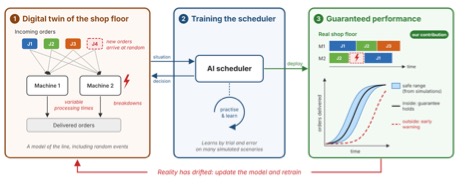
Figure: (1) A model of the shop floor captures random events such as breakdowns and new orders; (2) an AI scheduler is trained on this model; (3) our contribution: on the real shop floor, its performance is checked against a guaranteed range. Leaving the range triggers an update of the model and new training.
Next steps
From January 2027, we will explore this approach in a student research project co-supervised with colleagues at ZHAW and inspire. On our side, the focus is on studying what happens when reality drifts away from the model, computing performance guarantees for the trained scheduler and, ultimately, testing them on real manufacturing data.
More broadly, this work is part of our effort to make digital twins more reliable: using statistics to check models built from data and expert knowledge against what is actually observed, so that they can support decisions with guarantees.
Looking ahead
Resilient manufacturing is not only about reacting quickly to disruptions; it is also about knowing when the tools we rely on stop being reliable. By combining AI-based planning with statistical guarantees, we aim to help European manufacturers adopt AI scheduling with confidence, knowing both what performance to expect and when to act.
Adrien Banse, Automatic Control Laboratory, ETH Zurich
