
Represented by IDENER, the DMaaST project contributed to HaDEA’s discussions on the practical deployment of artificial intelligence across Europe’s strategic sectors.
Porto, Portugal | 14 October 2026
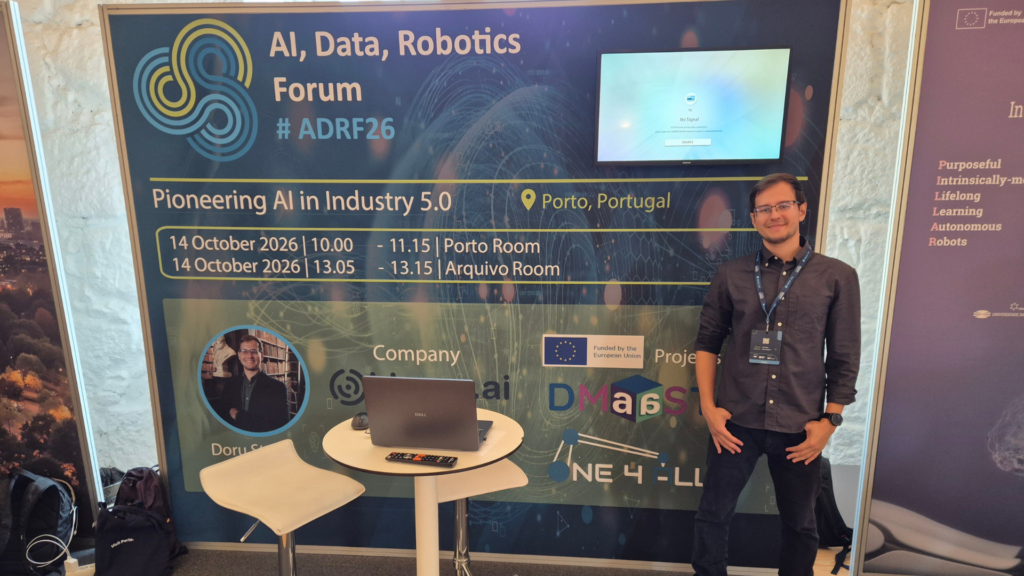
The DMaaST project participated in the European AI, Data and Robotics Forum (ADRF 2026), held in Porto on 13–14 October 2026, contributing to discussions on how artificial intelligence can move beyond research environments to deliver reliable, practical solutions for European industry.
Representing DMaaST, Doru Stefan Andreiana, Team Leader and Mechatronics and Robotics Engineer at IDENER, joined the workshop “AI in Strategic Sectors: Manufacturing, Mobility, Energy & Climate, Healthcare”, organised by the European Health and Digital Executive Agency (HaDEA) on 14 October.
His contribution presented DMaaST’s approach to strengthening manufacturing resilience through trustworthy data exchange, cognitive digital twins and AI-driven decision support, highlighting the importance of developing intelligent industrial systems that are not only technologically advanced but also transparent, reliable and responsive to real operational needs.
Bringing European AI Innovation Closer to Industrial Reality
Organised by the AI, Data and Robotics Association (Adra) in collaboration with the European Commission, the European AI, Data and Robotics Forum is a key meeting point for Europe’s research and innovation community.
The 2026 edition brought together more than 500 experts and stakeholders to explore how advances in artificial intelligence, data technologies and robotics can strengthen European competitiveness, technological sovereignty and industrial innovation.
As part of the programme, HaDEA organised a series of workshops addressing some of the most pressing challenges associated with the deployment of AI, including trustworthy autonomous systems, applications in strategic sectors, human-centric innovation and the translation of research outcomes into policy.
The workshop held on 14 October brought together representatives from four EU-funded projects working across different application domains: COSMIC, represented by Rafael Monge Palma; DMaaST, represented by Doru Stefan Andreiana; PRIMI, represented by Alessandro Di Nuovo; and TURING, represented by Konstantinos Tserpes.
Although their applications ranged from manufacturing and energy to healthcare and critical scientific infrastructure, the discussion highlighted a common challenge: ensuring that AI-generated predictions and recommendations can be trusted, validated and effectively integrated into human decision-making processes.
DMaaST’s Approach: From Reliable Data to Actionable Industrial Intelligence
During his presentation, Doru Stefan Andreiana introduced DMaaST’s work towards developing smarter, more resilient and sustainable manufacturing value networks.
A central theme was the difficulty of translating advances in artificial intelligence into dependable industrial applications. Despite the considerable potential of AI, its deployment in manufacturing continues to face significant barriers, including fragmented and inconsistent data, privacy and security concerns, limited model transparency and the challenge of converting predictions into practical operational decisions.
To address these limitations, DMaaST is developing its Smart Manufacturing Assessment Platform (SMAP), which brings together complementary technologies to support more informed and adaptive industrial decision-making.
The platform is built around several interconnected capabilities.
Trusted and interoperable industrial data. Through Decentralized Knowledge Graphs (DKGs), DMaaST seeks to connect information across manufacturing organisations while preserving data ownership, privacy and traceability. This approach enables manufacturers to share and access verifiable information without replacing their existing systems or compromising commercially sensitive data.
Cognitive digital twins for disruption anticipation. DMaaST combines operational data with expert knowledge to develop digital representations of manufacturing processes and value chains. These models are designed to help identify potential bottlenecks, anticipate disruptions and evaluate alternative production scenarios with greater transparency and confidence.
AI-powered multi-objective decision support. By integrating multi-agent AI approaches and optimisation algorithms, the platform aims to support manufacturers in assessing different operational strategies, balancing competing objectives and adapting production and logistics to changing conditions. Rather than providing predictions alone, the objective is to translate analytical insights into actionable recommendations.
Human-centred and sustainable decision-making. DMaaST also incorporates human expertise into its decision-support processes, recognising that industrial AI must remain understandable and accountable to the professionals using it. Alongside this, sustainability and circularity assessment capabilities are being integrated to support more informed decisions on resource efficiency and environmental performance.
Together, these technologies reflect DMaaST’s wider ambition to establish a manufacturing ecosystem in which reliable data, intelligent modelling and human expertise work together to improve resilience across industrial value chains.
Validating Innovation Through Real Manufacturing Environments
An important aspect of DMaaST’s contribution to ADRF 2026 was its emphasis on connecting technological development with practical industrial requirements.
The project is working with two industrial partners representing distinct manufacturing environments: JPB Système in France, specialising in innovative locking solutions for critical aerospace applications, and Kamstrup in Denmark, a technology company specialising in intelligent metering solutions.
These demonstration cases provide the industrial settings in which DMaaST’s technologies are being developed and assessed, addressing challenges such as production bottlenecks, disruption anticipation, data interoperability, product traceability and sustainability assessment.
By considering both individual production processes and the wider value chain, the project aims to demonstrate how intelligent manufacturing systems can support more effective coordination, improve the ability to respond to unforeseen events and strengthen operational resilience.
The use cases also underline the importance of ensuring that AI solutions are grounded in real manufacturing conditions, where recommendations must account for technical constraints, operational priorities and the knowledge of experienced professionals.
Trustworthy AI as a Foundation for Europe’s Industrial Future
One of the central messages emerging from HaDEA’s workshop was that the successful adoption of artificial intelligence depends on more than the performance of algorithms.
Across strategic sectors, two considerations remain particularly important: the reliability of automated decisions and the confidence of the people expected to act upon them.
In industrial environments, where decisions may affect production continuity, resource allocation, safety and sustainability, transparency and validation are essential to building that confidence.
DMaaST’s approach directly addresses these considerations by combining verifiable data, traceable modelling, explainable decision-support mechanisms and human involvement throughout the decision-making process.
This perspective also aligns with the broader objectives of European research and innovation initiatives, which seek to accelerate the adoption of advanced digital technologies while ensuring that their deployment remains trustworthy, responsible and beneficial to industry and society.
Strengthening Collaboration Across Europe’s AI Ecosystem
DMaaST’s participation in ADRF 2026 provided an opportunity to share the project’s research approach with the wider European AI, data and robotics community and to contribute to discussions on the challenges of deploying intelligent technologies in demanding operational environments.
The exchange of perspectives between projects working in manufacturing, healthcare, energy and critical infrastructure reinforced the relevance of cross-sector collaboration in addressing shared challenges around AI reliability, validation and human acceptance.
As DMaaST continues to advance its Smart Manufacturing Assessment Platform and industrial demonstration activities, engagement with European initiatives such as ADRF remains valuable for connecting research developments with industrial needs and contributing to the wider adoption of trustworthy AI.
The project’s participation reflects its commitment to a future in which manufacturing networks are not only more intelligent and interconnected, but also more resilient, sustainable and capable of adapting to an increasingly complex industrial landscape.
